Calibration is historical
The chosen risk allocation uses the full historical interval. There is no independent forward validation of these portfolio weights. Losses and prolonged drawdowns remain possible.
D7 / EA PORTFOLIO
An established collection of trading approaches, brought together with configurable risk at each trade’s existing stop.
Explore the historical evidence01 / HISTORICAL EVIDENCE
2020-01-01 – 2026-10-02 · MetaQuotes-Demo
USD 10,000 initial capital · 1-minute OHLC (Model 1)
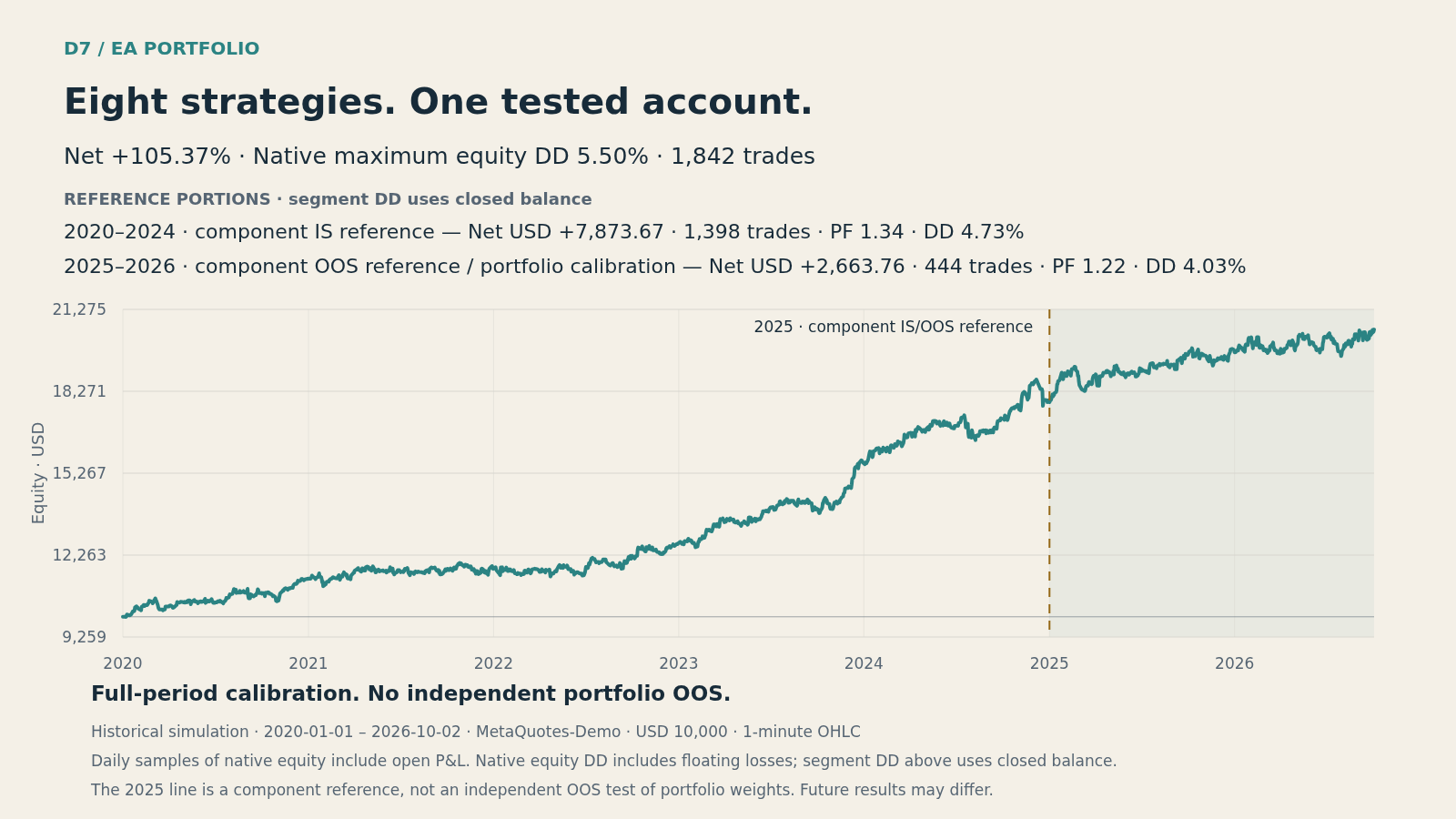 Open full-size chart
 Scroll the table horizontally to see trades, drawdown and costs
| Displayed portion | Net USD | Closed trades | PF | Closed balance DD | Commission USD | Swap USD |
|---|---|---|---|---|---|---|
| 2020–2024 · component IS reference | +7,873.67 | 1,398 | 1.34 | 4.73% | 0.00 | -991.94 |
| 2025–2026 · component OOS reference / portfolio calibration | +2,663.76 | 444 | 1.22 | 4.03% | 0.00 | -294.20 |
Native entries: 1,530 long and 312 short. Commissions 0.00 USD; swap -1,286.14 USD; separate fees 0.00 USD. These trading costs are already included in net results; spread is reflected in fills. Software rental fees are not deducted from the backtest. Minimum native margin level: 105.17% (equity / used margin). Reference leverage is 1:500; other contracts or leverage can prevent entries or alter results.
Equity includes open P&L; the plotted series is sampled from native account marks. Maximum equity drawdown comes from the native report under the 1-minute OHLC model. Segment drawdown uses closed balance and does not represent floating losses. Segment cash flow follows deal dates; trade counts and net trade PF follow closing dates. These are portions of one continuous account. Calendar dates are native broker server dates.
02 / COMPOSITION
Original signals, stops, targets and exits.
The portfolio allocates the risk budget.
US equities · AMD
US equities · AAPL
FX · USDSEK
Gold · XAUUSD
Gold · XAUUSD
FX · GBPUSD
US index · US500
FX · EURUSD
Six published EAs and two individually approved IS/OOS strategies. The individual evidence windows differ: Praxis uses a legacy 2024+ holdout. Aether’s 2025 period was exposed during strategy selection and is not its untouched OOS; its qualified untouched OOS starts in 2026. SEK standalone defaults to TIME_ONLY; this portfolio embeds the tested R_TARGET 1.50R preset. Counts and directions describe this joint historical account, not future frequency. Earlier individual qualification does not certify future portfolio returns.
03 / INSTALLATION
Use a compatible MT5 hedging demo account first. The portfolio requires the exact tested instruments and their historical data.
Required: AMD, AAPL, USDSEK, XAUUSD, GBPUSD, US500 and EURUSD. Equity modules also require peer-symbol data (NVDA and INTC). Broker symbols and contracts must match the validated setup. Modules with absent required symbols remain uninitialized; their allocations are not redistributed. Availability is rechecked only when the Expert is reinitialized. Check the chart status: a partial composition does not reproduce the displayed eight-module account.
Reference host chart: XAUUSD M1. Each component reads its own market context internally. Run only one portfolio Expert instance per account, and keep standalone component copies off that account to avoid position conflicts.
The measured preset requests a total potential risk budget of 5%. This is allocated to new trades. It is not a maximum daily loss or a maximum account drawdown. Volume steps, margin, gaps and fills can change realized risk. Accepted aggregate input range: 0.95%–6.78%. Native filled-entry stop risk in the measured account ranged from 0.042% to 1.471% of sizing equity across 1,842 entries. This is each filled trade’s risk to its original SL at the native conversion rate; it excludes costs and gaps beyond the stop.
04 / BEFORE YOU USE IT
The chosen risk allocation uses the full historical interval. There is no independent forward validation of these portfolio weights. Losses and prolonged drawdowns remain possible.
Retained event calendars have fixed endpoints. Treasury’s retained calendar ends in 2025; it cannot generate new event entries beyond that coverage. Buyback’s retained calendar reaches July 2026. All eight modules remain embedded; future event entries in these two modules require qualified calendar coverage.
The two gold modules preserve their original foreign-position guards, so one can block the other. Hedging alone does not remove these exclusions. Individual small samples and weak recent results remain limitations.